

Today marks the first anniversary of the signing of the Establishment Agreement of the International Mangrove Center (IMC). As night falls, the square in the southern area of Shenzhen International Garden and Flower Expo Park (hereinafter referred to as the Garden Expo Park) is softly lit, with plants whispering in the gentle breeze. International Mangrove Night 2025, themed "Beauty in Diversity," was held here. This event is Shenzhen's anniversary gift to the International Mangrove Center, showcasing a vivid picture of global collaboration in protecting coastal ecosystems.
This event was jointly hosted by the International Mangrove Center, Planning and Natural Resources Bureau of Shenzhen Municipality, Foreign Affairs Office of the Shenzhen Municipal People's Government, Culture, Radio, Television, Tourism, and Sports Bureau of Shenzhen Municipality, Urban Management and Law Enforcement Bureau of Shenzhen Municipality, and the People's Government of Futian District. The event revolved around the core themes of "ecology + technology + culture," featuring five thematic exhibition zones, covering technological interactions, natural bazaars, international exchanges, and immersive art experiences. The aim was to integrate mangrove conservation into the daily lives of citizens through tangible, interactive, and participatory experiences.
On the evening of November 6th, International Mangrove Talk 2025, as a key part of the event, was held at the Garden Expo Park. Under the theme "Implementing the 'Mangrove+' Initiative to Jointly Build a Community with a Shared Future for All Life on Earth," the event brought together government officials, experts, scholars, and representatives of enterprises and social organizations from over 20 countries to discuss global pathways for mangrove conservation and sustainable development.
In his speech, Prof. Bao Daming, Director-General of the IMC Interim Secretariat, emphasized that mangroves are the "silent guardians of the coastline," playing an irreplaceable role in addressing climate change, protecting biodiversity, and supporting the livelihoods of coastal communities. He noted that since its establishment in November 2024, the IMC has brought together 20 signatory countries and is becoming a hub for global mangrove conservation and cooperation. "The IMC upholds the 'Mangrove +' concept, advocates 'shared actions,' and is taking new strategic steps to promote the harmonious development of human civilization by deeply integrating mangrove conservation with technology, education, cultural exchanges, and international cooperation," he stated, clearly outlining the IMC's future action plan.
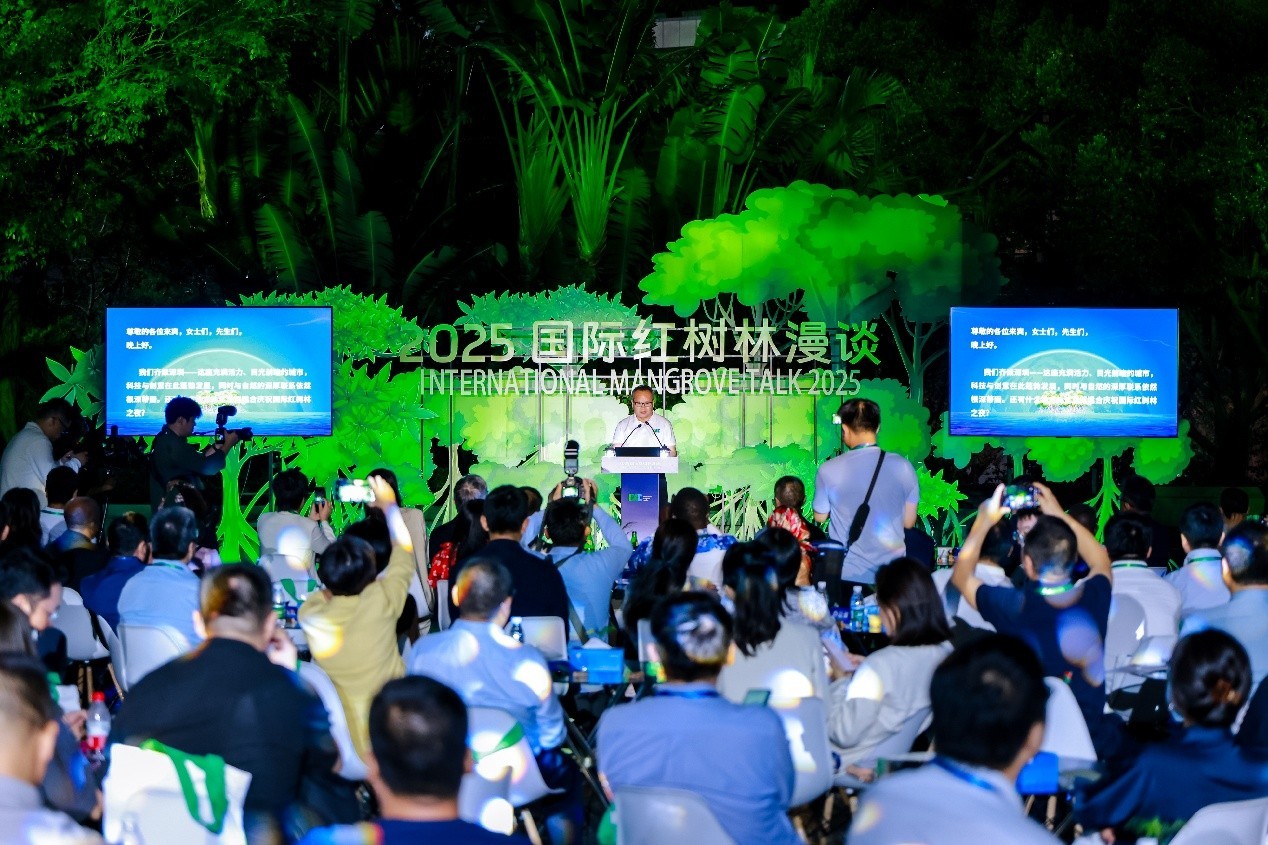
The picture shows the scene of the International Mangrove Talk 2025.
The keynote speech session focused on three major topics under the "Mangrove+" theme, with several experts sharing cutting-edge practices and insights.
Mr. Lai Chun-chi, Deputy Director of the Agriculture, Fisheries, and Conservation Department of Hong Kong, delivered a speech titled "Mangrove Conservation and Global Collaboration in Hong Kong," sharing the experience of the Mai Po Nature Reserve in wetland management, invasive species control, and smart monitoring. He emphasized the interconnection of the mangrove ecosystems in Shenzhen and Hong Kong and the importance of collaborative conservation.
In his report "Mangrove Blue Carbon and Climate Change Response," Professor Lin Guanghui from Tsinghua University systematically explained the ecological value of mangroves, the potential of blue carbon development, and the significance of international cooperation, offering key insights for global climate governance and ecological collaboration. He proposed that Shenzhen should serve as a bridge, both sharing China's experiences internationally and actively learning from advanced global practices. Through multi-channel exchanges and collaboration, Shenzhen can work with global forces to protect mangrove ecosystems and contribute Chinese wisdom and solutions to global climate governance.
In his speech "Beauty in Diversity, 'Mangrove+': Empowering High-Quality Urban Development with Ecological Collaboration," Mr. Shan Liang, Director of the Urban Planning and Land Development Research Center of Shenzhen Municipality, elaborated on Shenzhen's innovative approach to promoting ecological collaboration and high-quality urban development through the "Mangrove+" concept. He stated that Shenzhen is demonstrating through concrete actions that ecological conservation and high-quality development are not mutually exclusive but complementary paths to shared success.
International Mangrove Talk 2025 is an important practice for Shenzhen in implementing the "Mangrove+" action plan and operating the International Mangrove Center with high quality, showcasing Shenzhen's responsibility and openness as the host city of the IMC headquarters.
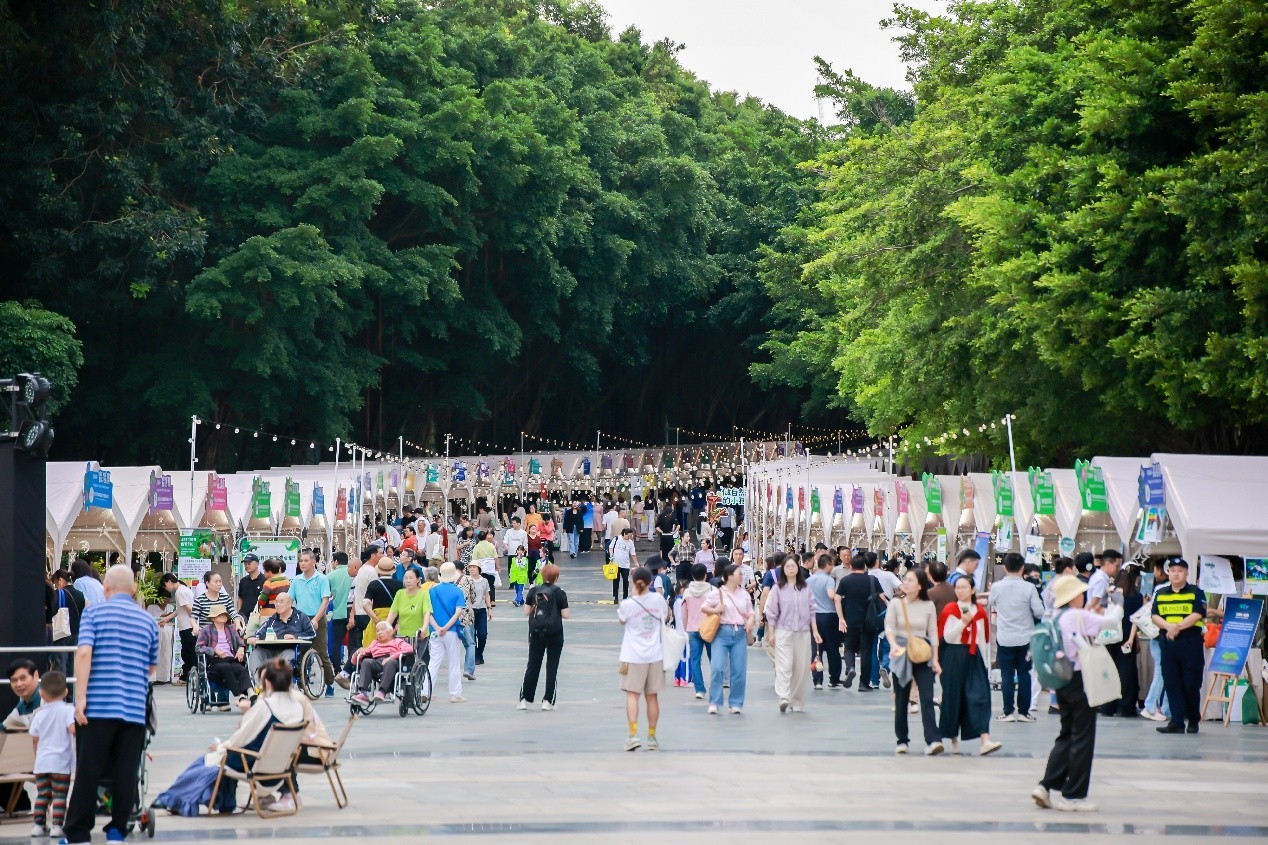
The picture shows the exhibition area of the International Mangrove Night 2025.
While rational discussions sparked wisdom within the venue, emotional resonance flowed quietly through the night at the Garden Expo Park. Experts and scholars engaged in in-depth dialogues on topics such as mangrove restoration standards, blue carbon trading mechanisms, and cross-border ecological corridor construction. This is not only an academic exchange but also a critical step in advancing global mangrove governance from consensus to action.
This is perhaps the most profound interpretation of "Beauty in Diversity": an initiative born in Shenzhen has now blossomed into a cross-border consensus on mangrove conservation. Over the past year, from the initial 18 signatory countries to the current 20 standing together, and to tonight's concentrated experiences, ecological collaboration has become a bond connecting the world, illuminating a clear future of harmonious coexistence between humanity and nature.