

On May 14, 2025, a delegation from the Forestry and Wetland Administration Bureau of Haizhu, Guangzhou, visited the Interim Secretariat of the International Mangrove Center (IMC). The discussions focused on the application of wetland-related new quality productivity scenarios, digital information, and collaboration in public education and awareness campaigns. Representatives from both sides engaged in in-depth exchanges.
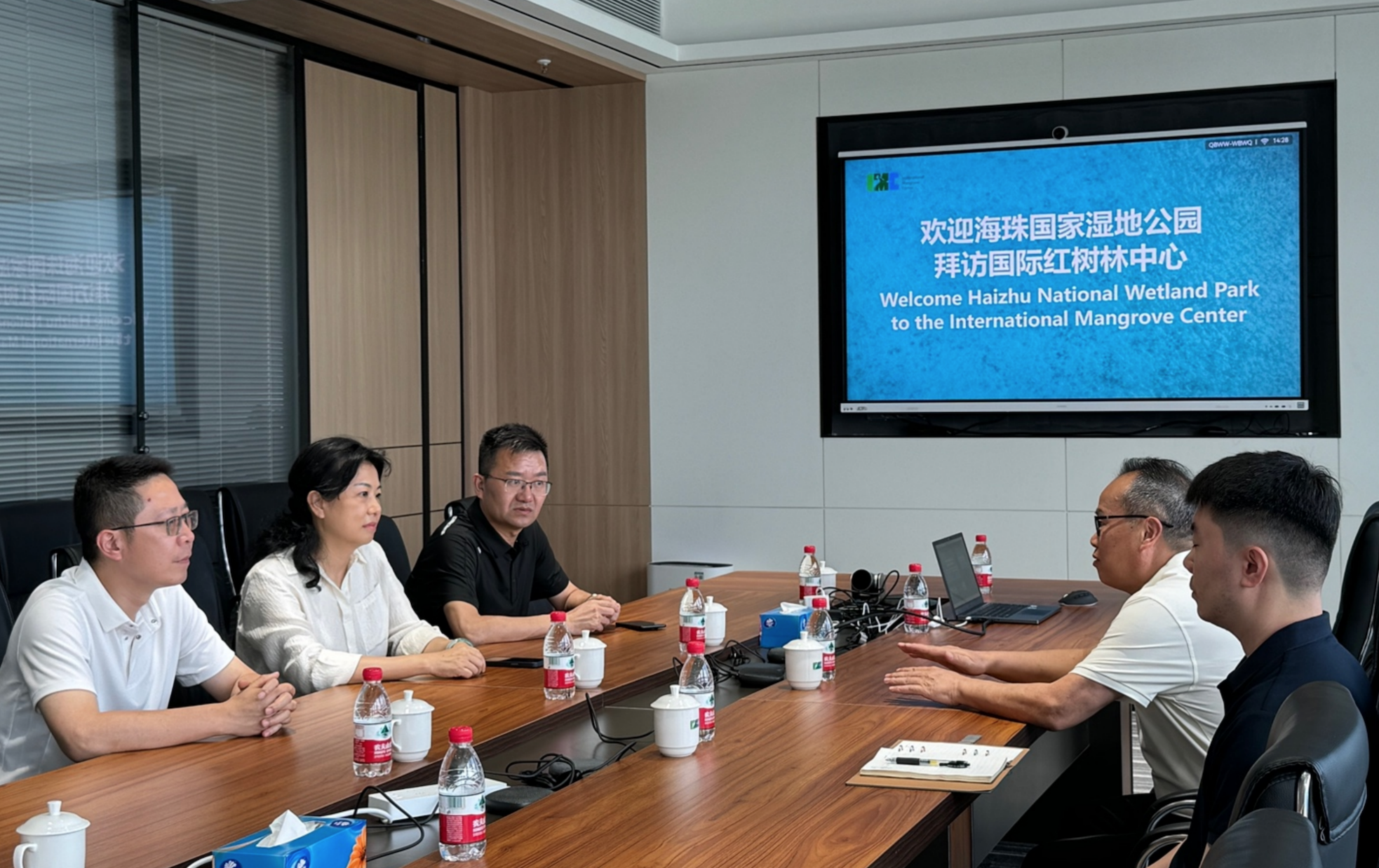 Collaborative discussion between the Forestry and Wetland Administration Bureau and the IMC
During the meeting, Prof. Bao Daming, Director General of the IMC Interim Secretariat, extended a warm welcome to the delegation and introduced the IMC’s development history, key focus areas, and recent initiatives. He emphasized that the Guangzhou Haizhu National Wetland Park serves as a vital "ecological green heart" for the city, with extensive forward-looking practical experience in ecological restoration, new quality productivity applications, and nature education. He expressed hope that both parties could leverage their complementary resources to collaborate on intelligent management and public education.
Ms. Cai Ying, Director of the Forestry and Wetland Administration Bureau of Haizhu District, highlighted that in recent years, the park has been actively exploring development models integrating wetland conservation with artificial intelligence, digital platforms, and the low-altitude economy, with a focus on the synergistic integration of protection and development. She expressed eagerness to collaborate with the IMC in applying new quality productivity and advancing public education and awareness, jointly promoting innovative practices in wetland ecological conservation and sustainable development.
This exchange laid a solid foundation for establishing future cooperation mechanisms and building a model for smart wetlands. Moving forward, both parties will continue to deepen communication, explore practical collaboration pathways, and jointly contribute to the development of a modern wetland management system that fosters harmonious coexistence between humans and nature.